Category: resuscitation

Resus room processes, airway, critical care and crisis resource management

  • Why cricoid pressure doesn’t work (probably)

    by Josh Holden FACEM CCPU

    Ever wondered why we don’t use cricoid pressure in ED? After all, compressing the oesophagus between the larynx and C5 vertebral body should stop any breakfast from coming up the wrong way quite nicely?


    Check out the ultrasound video below to see the whereabouts of Jonathon Au’s foodpipe, and what might happen (other than ruining your intubation view) if you give his larynx a choke hold:

    As you can see his oesophagus lies lateral to the trachea, not below it as commonly assumed. 


    This seems to be completely normal. Dynamic MRI studies demonstrate that application of pressure to the cricoid cartilage displaces the oesophagus laterally instead of occluding it (Smith 2003, Boet 2012). An ultrasound study demonstrated similar findings: in 60% of patients the oesophagus was lateral to the airway and cricoid pressure led to displacement rather than occlusion in all patients. (Tsung 2012). Old news then…
  • Education Session: Shock

    Education Session: Shock

    Knowledge Review Quiz here

    Cases we discussed are here

    PEA

    Causes of elevated LACTATES

    Venue Ultrasound : Auto VTI Demo

    Femoral vs radial arterial lines, and non-invasive vs invasive BP measurement (PulmCrit): http://emcrit.org/pulmcrit/a-line/

    Other references:

    1. Perner A, Cecconi M, Cronhjort M, Darmon M, Jakob SM, Pettilä V, et al. Expert statement for the management of hypovolemia in sepsis. Intensive Care Med. 2018 Apr 25;44(6):791–8.

    2. Marik PE. Fluid Responsiveness and the Six Guiding Principles of Fluid Resuscitation. Critical Care Medicine. 2016 Oct;44(10):1920–2.

    3. Dynamic LVOTO: https://echo.anesthesia.med.utah.edu/dynamic-obstruction/

  • Education Session: Ambu aScope

    ascope

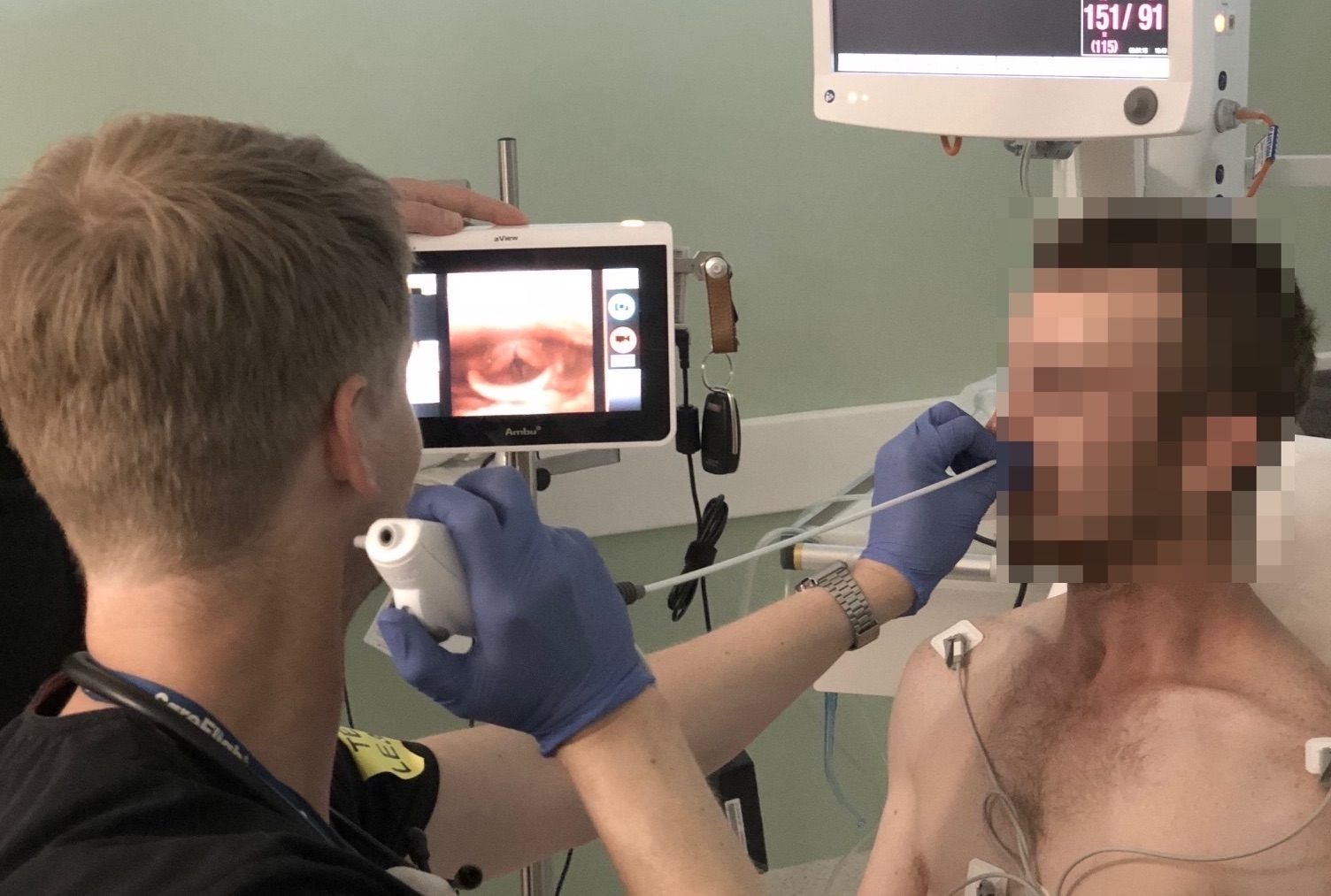
    Here is the pre-reading for the Education Session on the Ambu aScope.

    Objectives for the session:

    1. Indications for endoscopic airway instrumentation

    (1) looking at airways (eg. burns, FBs, stridor)

    (2) awake fibreoptic intubation

    (3) intubation through a supraglottic device following failed intubation

    2. Discussion of recent cases

    3. Patient preparation

    4. Airway local anaesthetic topicalisation

    5. Environment preparation

    6. Use of the aScope

    Device familiarisation

    The aView Monitor:

    One of the consultants got intubated by his registrars. It shows the challenge of topicalisation in a non-sedated patient who has not received an antisialogogue:

    Further comments and reflection by the intubatee are documented here

    The retrieval service (Greater Sydney Area HEMS) has been using the aScope for several years and has some useful aides-memoire and checklists available below.

  • NIV in ED

    My talk from today:

    NIV in ED

  • Drowning

    My presentation from today looking at basics of drowning, with a link to the flowchart from Tintinalli.

    Drowning

    Flowchart (Tintinalli)

  • Resus Topic: Vascular Access

    Our first resus topic of the month is Vascular Access. Here are the questions, which you can download as a PDF here

    Resus Topic of the Week: Vascular Access

    1. Where are central venous catheters (CVCs) kept?
    2. What are indications for CVCs in ED?
    3. Which veins do we put CVCs in?
    4. What are the pros and cons of these sites?
    5. How do we reduce the risk of catheter-related blood stream infection when inserting CVCs in the ED?
    6. What lines other than the multi-lumen CVCs are available for resuscitation through a central vein?
    7. Where are these kept?
    8. Where is the EZ-IO kept?
    9. Which two main sites can be cannulated intraosseously with this device?
    10. Which site allows more rapid infusion?
    11. When would you use a pink, blue, or yellow IO needle?
    12. Describe the landmarks for proximal humeral insertion
    13. Describe the landmarks for proximal tibial insertion
    14. What lab tests can be done on an intraosseous specimen?

    Try to answer them all before clicking here for the answers!

  • Crisis resource management

    2-3 weeks ago, we did a Sim session, and part of the discussion/teaching was on crisis resource management (we even had observers use a checklist). Here is more information, which includes 2 videos by our own Cliff Reid towards the middle and end.

    Emergencypedia – CRM


  • New CO2 cables in Resus

    We’ve moved to using new sidestream end tidal carbon dioxide adaptors in resus.

    A video on how to connect them is here:

    Remember, end tidal CO2 detection, or capnography, is mandatory in ALL intubations, including cardiac arrest. It is the most reliable way of confirming that the tracheal tube is in the airway (as opposed to the oesophagus).