Author: Cliff Reid

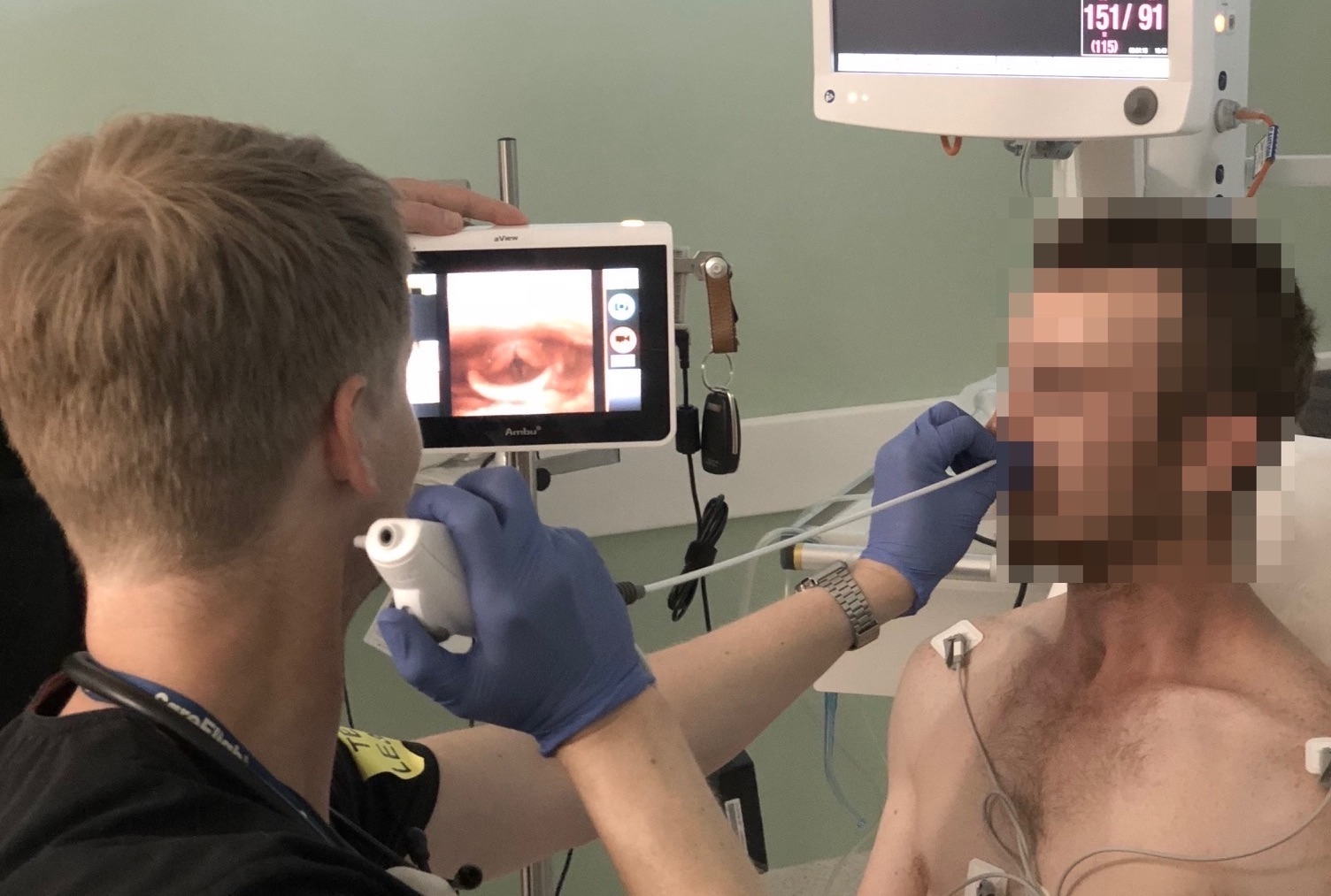
  • Education Session: Ambu aScope

    ascope

    Here is the pre-reading for the Education Session on the Ambu aScope.

    Objectives for the session:

    1. Indications for endoscopic airway instrumentation

    (1) looking at airways (eg. burns, FBs, stridor)

    (2) awake fibreoptic intubation

    (3) intubation through a supraglottic device following failed intubation

    2. Discussion of recent cases

    3. Patient preparation

    4. Airway local anaesthetic topicalisation

    5. Environment preparation

    6. Use of the aScope

    Device familiarisation

    The aView Monitor:

    One of the consultants got intubated by his registrars. It shows the challenge of topicalisation in a non-sedated patient who has not received an antisialogogue:

    Further comments and reflection by the intubatee are documented here

    The retrieval service (Greater Sydney Area HEMS) has been using the aScope for several years and has some useful aides-memoire and checklists available below.

  • Resus Topic: Vascular Access

    Our first resus topic of the month is Vascular Access. Here are the questions, which you can download as a PDF here

    Resus Topic of the Week: Vascular Access

    1. Where are central venous catheters (CVCs) kept?
    2. What are indications for CVCs in ED?
    3. Which veins do we put CVCs in?
    4. What are the pros and cons of these sites?
    5. How do we reduce the risk of catheter-related blood stream infection when inserting CVCs in the ED?
    6. What lines other than the multi-lumen CVCs are available for resuscitation through a central vein?
    7. Where are these kept?
    8. Where is the EZ-IO kept?
    9. Which two main sites can be cannulated intraosseously with this device?
    10. Which site allows more rapid infusion?
    11. When would you use a pink, blue, or yellow IO needle?
    12. Describe the landmarks for proximal humeral insertion
    13. Describe the landmarks for proximal tibial insertion
    14. What lab tests can be done on an intraosseous specimen?

    Try to answer them all before clicking here for the answers!

  • Status Epilepticus Sim 2016-05-26

    This hypothetical case was simulated today with resident medical staff and nursing staff.

    The Case

    An obese 40 year male with type 2 diabetes mellitus presented in status epilepticus.
    He had taken an oral hypoglycaemic agent but rather than have breakfast he went on a pub crawl to celebrate his 40th birthday. He then collapsed and had tonic clonic seizures. He had been given intramuscular midazolam by paramedics.

    The Objectives

    Prepare for patient arrival, organise team and allocate roles. Manage airway, control seizures, identify and treat the underlying cause.

    The Learning Points – Clinical

    1. Position is EVERYTHING in airway management. Don’t forget to align the external auditory meatus with the suprasternal notch horizontally (this applies to all ages and sizes of patient), with the face parallel to the ceiling.

    2. Optimal bag mask ventilation involves a two person technique, allowing maintenance of an effective jaw thrust and good mask seal, with the use of airway adjuncts (oro- or naso-pharyngeal airways, or both):
    ear-to-notch

    3. Although the intraosseous route is preferred if there are delays in securing vascular access, it is not ideal for sampling for laboratory investigations. Blood can be taken from a large venous or arterial stab (eg. femoral vein) simultaneous to intraosseous insertion.

    4. Intraosseous access does not have to be limited to the tibia! In some patients, the humeral head site may be preferable.

    5. Not every comatose patient needs to be intubated. Plot the trajectory of their clinical state: if they’re improving and you’ve fixed the underlying cause, they may wake up (eg. post-hypoglycaemia or post-ictal). Actively support the airway in the meantime and if you need to set up for intubation use the checklist as a guide.

    The Learning Points – Non-Clinical

    1. Having a nursing and medical team leader working side by side works well in resuscitation due to the multiple tasks needing to be allocated to staff who are at various points on the skill-mix spectrum.

    2. Medication orders should be written down to minimise misunderstanding and drug errors. It is the medical team leader’s responsibility to make this happen.


  • Cardiac Arrest Sim 2016-04-06

    ECG-hyperK

    A case of hyperkalaemia resulting in ventricular fibrillation followed by symptomatic bradycardia was simulated.

    The simulation highlighted some great learning points worth sharing:

    1. In cardiac arrest, it is worth having both medical and nursing team leaders, with physicians focusing on diagnosis and treatment of the underlying cause and nurses running the cardiac arrest algorithm.
    2. The use of role & name stickers helps clarify everyones part in the team and improve communication.
    3. Requests for additional medications  / CVC set up etc. should be directed to the nurse team leader clearly and slowly, ensuring the scribe has also heard.
    4. It is worth slowing down and communicating with full words rather than acronyms, and ensuring the mental model of current status (Update) and next steps (Priorities) is shared (Team Leaders should speak ‘UP‘!).
    5. Everyone in the team has a right and a responsibility to know what’s happening and to speak up if something seems wrong.

    The team did a great job, recognising and managing the VF and the symptomatic bradycardia, diagnosing the acute kidney injury with hyperkalaemia early and initiating appropriate therapy. Another manikin’s life saved!


    Here are some references related to the concepts discussed in the debrief:

    1. The variable ECG changes seen in hyperkalaemia (scroll down for the ECGs): http://lifeinthefastlane.com/ecg-library/basics/hyperkalaemia/

    2. Therapies for hyperkalaemia (scroll down to ‘Management of hyperkalaemia): http://lifeinthefastlane.com/hyperkalemia/
    – make sure you watch the ER video included in that post!

    3. In a Scandinavian resuscitation study, higher performing teams showed more effective information exchange and communication, and sharing mental models predicted effective medical management.
    Westli HK, Johnsen BH, Eid J, Rasten I, Brattebø G. Teamwork skills, shared mental models, and performance in simulated trauma teams: an independent group design. Scand J Trauma Resusc Emerg Med. 2010;18:47.


  • Cardiac Arrest Sim 2016-03-11

    vfisim

    A case of refractory ventricular fibrillation was simulated, outlining the challenges faced in a non-cardiac centre in a patient for whom standard Advanced Cardiac Life Support measures fail to achieve return of spontaneous circulation.

    The simulation highlighted some excellent approaches worth sharing:

    1. Having the nurse team leader ‘run the code’, ie. manage the cardiac arrest algorithm, was a highly effective way of allocating roles. This (a) ensured accurate timings, safe defibrillation, and effective task delegation (eg. drug preparation), and (b) freed the physician team leader’s cognitive capacity to focus on diagnosis, prognosis, effective management of the underlying cause, and steps ‘beyond the algorithm’.

    2. Including paramedics in the sim enabled the scenario to be run from the point prior to handover, enabling simulation of the Batphone call as well as the logistics of moving the patient from ambulance stretcher to bed.


    Here are some references related to the interventions tried and the concepts discussed in the debrief:

    Terminology: No flow / low flow vs ‘down time’ – http://resus.me/down-with-down-time/

    Meaney PA, Bobrow BJ, Mancini ME, Christenson J, de Caen AR, Bhanji F, et al.
    Cardiopulmonary Resuscitation Quality: Improving Cardiac Resuscitation Outcomes Both Inside and Outside the Hospital: A Consensus Statement From the American Heart Association. Circulation. 2013 Jul 22;128(4):417–35

    Art lines & titrated adrenaline: EMCrit Podcast 130 – Hemodynamic-Directed Dosing of Epinephrine for Cardiac Arrest

    Refractory VF: http://lifeinthefastlane.com/ccc/electrical-storm/ and http://www.emdocs.net/refractory-ventricular-tachycardia-approach-to-management/

    Esmolol: http://resus.me/esmolol-for-refractory-vf/

  • Resident Education 11-02-2016

    1400 Airway Mangement Checklist

    1430 Case Presentation

    1500 Airway Practical Skills

    • Basic Airway Management
    • Surgical Airway

    References / Further Reading:


  • Age adjusted D-dimer cut-off values

    Age adjusted D-dimer cut-off values (age×10 µg/L) improve specificity without losing sensitivity for venous thromboembolism. This could spare many elderly patients unnecessary imaging.

    Diagnostic accuracy of conventional or age adjusted D-dimer cut-off values in older patients with suspected venous thromboembolism: systematic review and meta-analysis
    BMJ. 2013 May 3;346:f2492
    http://www.ncbi.nlm.nih.gov/pubmed/23645857

  • Whiplash RCT

    Emergency department treatments and physiotherapy for acute whiplash: a pragmatic, two-step, randomised controlled trial
    Lancet. 2013 Feb 16;381(9866):546-56
    http://www.ncbi.nlm.nih.gov/pubmed/23260167

  • Registrar teaching 10th May 2013

    Emergency Neurology Updates

    1. Sensitivity of computed tomography performed within six hours of onset of headache for diagnosis of subarachnoid haemorrhage: prospective cohort study.
    Perry JJ, Stiell IG, Sivilotti ML, et al. BMJ. 2011 Jul 18;343:d4277Take home points: Non-contrast CTB performed within six hours of headache onset can be considered “rule out” test for subarachnoid haemorrhage, without performing an LP

    2. Do children with blunt head trauma and normal cranial computed tomography scan results require hospitalization for neurologic observation?TBI Study Group for the Pediatric Emergency Care Applied Research Network (PECARN). Ann Emerg Med. 2011 Oct;58(4):315Take home points: Kids with minor HI and a normal CTB are safe to discharge home

    3. Immediate and delayed traumatic intracranial hemorrhage in patients with head trauma and pre-injury warfarin or clopidogrel use.Clinical Research in Emergency Services and Treatment (CREST) Network. Ann Emerg Med. 2012 Jun;59(6):460-8Take home points: IC bleed is at common in patients taking clopidogrel alone. Delayed ICH is rare in patients taking warfarin or clopidogrel.

    4. Management of minor head injury in patients receiving oral anticoagulant therapy: a prospective study of a 24-hour observation protocol.Menditto VG, Lucci M, Polonara S, Pomponio G, Gabrielli A. Ann Emerg Med. 2012 Jun;59(6):451-5Take home points: 6% incidence of delayed ICH in warfarinised patients 24 hrs after an initial normal CTB

    5. An analysis of predictive markers for intracranial haemorrhage in warfarinised head injury patients
    Authors: Rendell, S et al. Emerg Med J. 2013 Jan;30(1):28-31.
    Take home points: Up to 15% of warfarinised patients have an abnormal CTB after head trauma. A subtherapeutic INR is not protective or predictive.

    6. The benefits and harms of intravenous thrombolysis with recombinant tissue plasminogen activator within 6 h of acute ischaemic stroke [IST-3]: a randomised controlled trialThe IST-3 collaborative group. Lancet. 2012 Jun 23;379(9834):2352

    Take home points: You need to read this one and come to your own conclusions. The following editorials may help clarify your viewpoint:

    • The Lancet, Volume 380, Issue 9847 p 1053, 22 September 2012
    • Emergency Medicine Australasia (2012) 24, 473–476
    • Emergency Medicine Australasia (2012) 24, 477–479

    Central venous catheters, CVP, and fluid responsiveness

    The five components of the ‘bundle’ that aim to reduce catheter-related blood stream infection are:

    • Hand Hygiene
    • Maximal Barrier Precautions Upon Insertion
    • Chlorhexidine Skin Antisepsis
    • Optimal Catheter Site Selection, with Avoidance of the Femoral Vein for Central Venous Access in Adult Patients
    • Daily Review of Line Necessity with Prompt Removal of Unnecessary Lines

    Further information is here.

    Fluid responsiveness

    The failure of CVP to predict fluid responsiveness is nicely demonstrated in this landmark study.

    A recent summary of methods of predicting fluid responsiveness is here.
  • New CO2 cables in Resus

    We’ve moved to using new sidestream end tidal carbon dioxide adaptors in resus.

    A video on how to connect them is here:

    Remember, end tidal CO2 detection, or capnography, is mandatory in ALL intubations, including cardiac arrest. It is the most reliable way of confirming that the tracheal tube is in the airway (as opposed to the oesophagus).

